
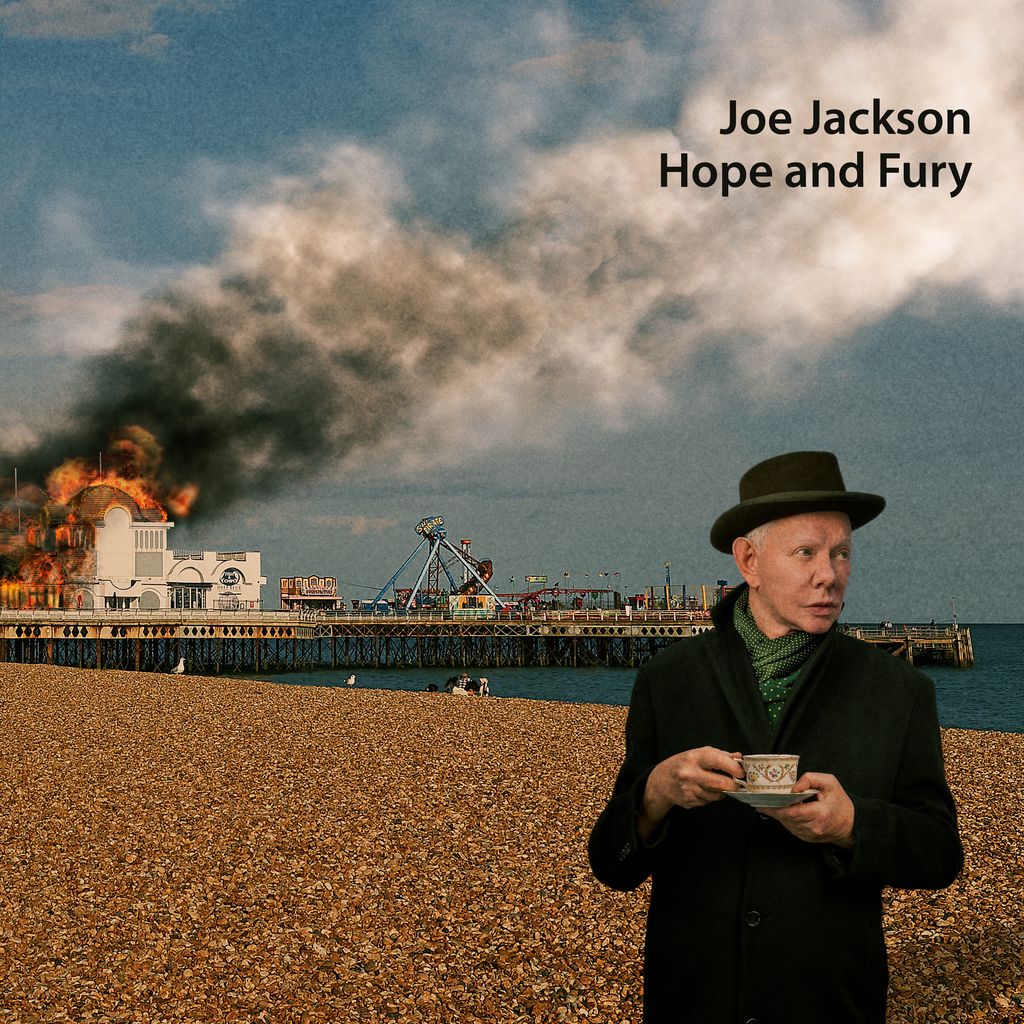
Ok, so you aren’t meant to judge a book by its cover. But with albums, it can be kinda hard not to (assuming you’re able to see the image, that is). The cover of Joe Jackson’s latest album – his 22nd, fact fans – shows him having a cup of tea on a beach, while behind him the pier of a traditional English seaside resort goes up in flames.
…So yes, there’s a bit of a love-hate relationship with England going on here lyrically. Having worked in various different genres, including jazz, classical and music hall over his fifty year career, here he’s back working in rock and pop, for his first studio album in seven years. He has described this album as ‘bicoastal Latin-jazz-funk-rock.’ When you get round to listening to it – hopefully very soon – you’ll realise that this is pretty on the money. And all in the best possible taste.
The album opens with the first single, ‘Welcome To Burning-By Sea.’ Within he sketches, with his characteristic sharp wit, a fictional English seaside town – inspired by Brighton and his hometown Portsmouth – which becomes a microcosm of the whole of the UK, with all its contrasts and contradictions. There’s a link that could probably be drawn with his late 1970s contemporaries (think Ian Dury, Elvis Costello, even Madness and John Cooper Clarke). It sets us up for the ride very nicely. ‘I’m Not Sorry‘ is as defiant as you might expect, and even more urgent – the lyric about ‘Don’t pass the matches when somebody’s burning a witch‘ is really rather fine. (I could quote endlessly from this song but go and investigate for yourself.)
Thinking back to the front cover, it’s rather nicely evoked on the penultimate track ‘End Of The Pier,’ which is a rather effective pun – the end of the pier often being the idea of acts going there to play out the end of their careers, or the pier literally going up in smoke. But the reality is all these nine tracks are astonishingly high quality. It’s really been a joy to spend time with this record.
So all in all, another fabulous Joe Jackson album. That’s not to say he’s simply repeating himself – he’s certainly not content to play the hits from over forty years ago. He’s still on top form, and while tracks may have echoes of previous songs from his back catalogue, it isn’t that he’s harking back to past glories, they’re simply stylistic flourishes that are characteristic of him, without being reductive. At 34 minutes this album doesn’t hang about, and now in his seventies his observations remain as sharp as ever and his songwriting as distinctive.