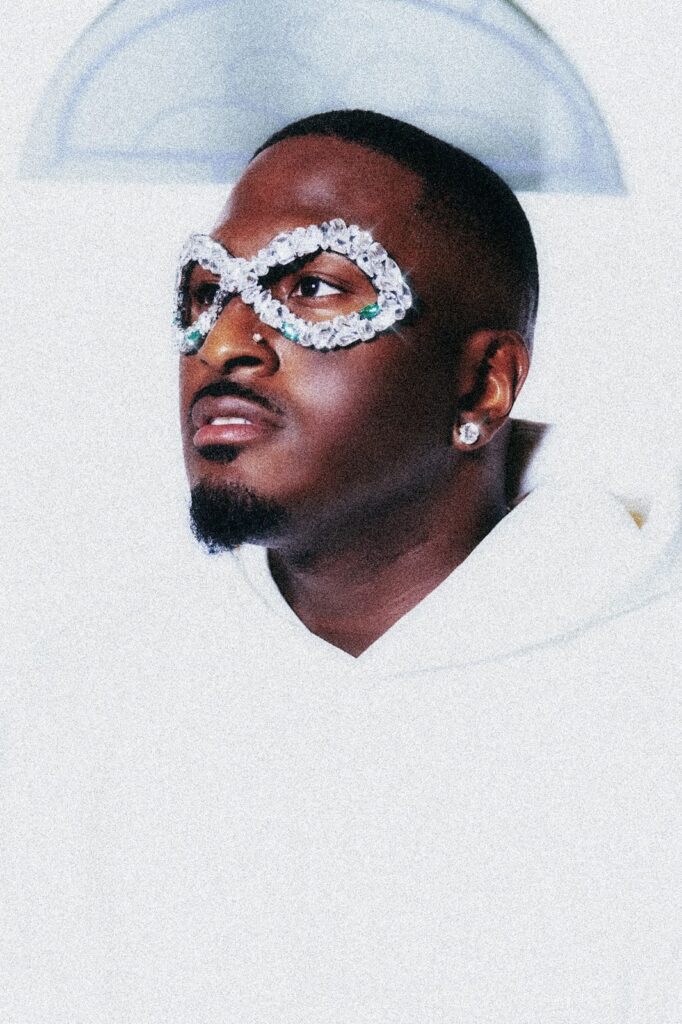
Ben Reilly by BANVOA
Ben Reilly is a Brooklyn-via-Atlanta rapper whose no-nonsense raps fuse superheroic mythmaking and clear-eyed vulnerability. He’s as likely to make you laugh out loud as he is to sketch out how his past and community have shaped him, for better and worse. In an exclusive op-ed for The FADER, Reilly contemplates the future of hip-hop in an era of artificial intelligence. — Vivian Medithi
Rap has always been a tool for the voiceless. At its core, hip-hop is about vocal authenticity. So why would a rapper prioritize algorithms, trends, and prompts over speaking up for those who need it?
These days we live in a world where computers could become competition for creators, but there’s no story in the algorithm. Over the past few years we’ve witnessed the adoption of Artificial Intelligence across music, gaming, photography, movies, television, and more. Hip-hop hasn’t been immune to the plague either, from Drake’s beef with Kendrick Lamar to Timbaland’s depressing new AI “artist.” As technology progresses, hip hop as a community, culture, and art form will have to choose whether to adapt and evolve in tandem with AI or in spite of it.
Drake and Kendrick’s beef is relevant for a few reasons. First, while we were waiting for either artist to respond to each other, we began to see leaks of upcoming diss records. But these “leaks” were actually created by lesser known artists using AI voice filters to cosplay bigger names. These vocal filters utilize AI to recreate an artist’s pitch, tone, cadence,and breathing patterns from publically available audio (interviews, music, speeches, etc).
While these songs briefly fooled many listeners, the truth eventually came out. On the surface, it could be viewed as a harmless prank, but the issue is bigger than it seems. Regardless of these AI disses’ quality (or lack thereof), it sets a dangerous precedent when audiences, knowing or unknowing, reshare this content as if it were real.
As an artist, I know how difficult it can be to maintain control over your intellectual property: the idea that someone can use my likeness to create not only a song, but imagery and narratives that oppose what I stand for as a human, scares me. While there are rules and standards governing the misuse of someone’s likeness and IP, the speed of AI development makes me wonder how long the fragile balance will last without improved regulation.
Where the previous example merely copies an artist’s likeness, I’m even more alarmed by those individuals using AI to pilfer others’ ideas, combining them with bits and pieces of other artists to Frankenstein someone or something new. So a decorated artist such as Timbaland parading around a new AI “artist” genuinely confuses me. In order to bring us “TaTa,” he had to sit down and write a prompt borrowing from existing artists to give his creation the facade of talent and personality. As a huge fan of Timbo and his work up until this point, I find myself wondering if he genuinely believes he needs AI to create the same sort of classics he did back in the day.
While I have plenty of reservations regarding AI in hip-hop, I know it can have some benefits. Take a legend like Beanie Sigel, who has suffered from a collapsed lung since a drive-by shooting in 2014. The former ROC-a-Fella member lost his voice and was forced to step back from music for quite a while. With the help of AI, Beanie was able to restore his voice on recordings, giving the Broad Street Bully another chance at music.
Or consider songwriting sessions. As a hip-hop artist, I don’t allow anyone to write for me. But I have written for others, and I’ve seen other writers use AI to create reference tracks for other artists. The idea is that vocal filters on reference tracks make it easier for an artist to see how the concept might work for them. I’d say this is one time where AI could be helpful rather than harmful.
Aside from the obvious IP rights violations involved with creating an AI artist, what truly offends me is the lack of a story. I’ll use myself as an example here: I’m a black male hip-hop artist born in Brownsville, Brooklyn, who grew up between New York and Atlanta. Both cities influence my style, my musical tastes, and my dialect. I come from a single parent household, and have been extremely vocal about the familial and community issues that shaped me. And I wear my love for comic books, movies, and geek culture on my sleeve. I’m telling my story not just for myself, but for all the people who share my experiences. That’s our responsibility as artists: truth, life, vulnerability.
Could a man-made artist created in seconds really have an origin story? Sure, if you program it. An artificially-generated artist might recite your lyrics or speak to experiences you plugged into it, but there’s no true connection. AI music makers aren’t looking to connect with people, but an algorithm. They may fool people at first; they may even sound nice. But when an “artist” fails to connect, the music will fail with it. And the choice to platform imaginary artists silences real voices by stealing them.