
Rich Fury / Getty Images
Monday night at the skaiwater show in Brooklyn, The FADER editorial director Steffanee Wang watched as several fans clambered on stage and launched themselves into the crowd. At some point, the crowd stopped catching the stage divers and began parting out of the way; it seemed a miracle nobody had broken their necks.
The vignette reminded me of peak SoundCloud days, when Lil Uzi Vert and Travis Scott were in their prime. Uzi’s classic leap at Rolling Loud was instantly iconic, part and parcel with his on-the-edge rockstar image. Lately, though, rap shows have reminded me more of Scott’s infamous 2017 concert at NYC’s Terminal 5, where he coaxed a young man into jumping from the balcony. It was still some rockstar shit, but the risk had been offloaded from the asset to the customer.
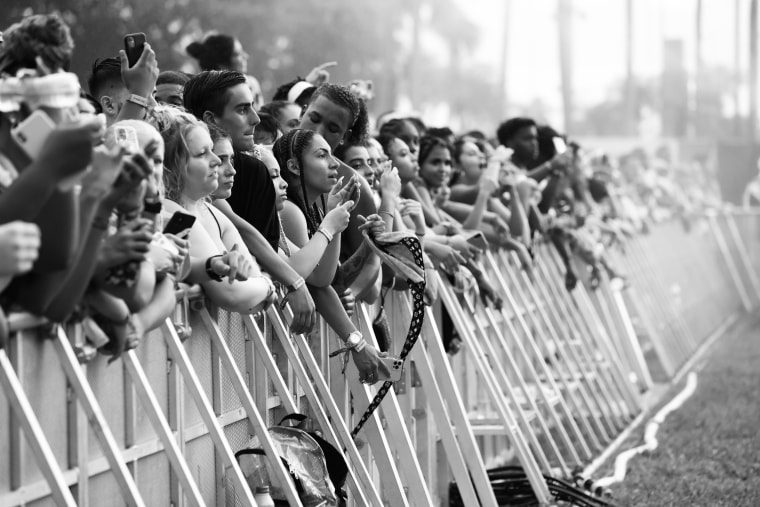
Feverish fans are of course happy to jump off stages and bridges if their favs so command them, but the lionization of those brave volunteers brings with it an unsentimental individualism. It’s become a common sight at shows to see fans in hi-vis vests with whistles, attempting to steer the crowd toward safety or chaos depending on their inclination; ditto for dressing up in inflatable costumes (bananas, Minions, etc) or Jesus cosplay for attention. Everyone seems mostly well-intentioned, but it speaks to a mindset that treats the concert venue as a place to be seen, rather than a place to share an experience. And that’s led to some oddly antisocial behavior infecting one of our last great communal third-spaces: the moshpit.
You know exactly what I mean. The guy (and yes, it’s always a guy) throwing his weight around aggressively no matter who’s beside him, or windmilling his arms hard as shit unconcerned about who he smacks. The guy who wants to shove everyone out of his way to get to the barricade, and will step on your toes to get there. Guys like this have always existed, but lately, it feels as if more and more of them are cropping up.
A few years ago, the prevailing wisdom was that moshpits at large had become more unruly and inconsiderate in response to the isolation of the pandemic. People had an excess of energy and were simply letting loose now that human contact was permissible again, or were perhaps too young to have been socialized into concert etiquette prior to COVID-19. But it’s been years since then, and the question still remains: why are moshpits so bad?
My coworker Tobias Hess posits that unlike DIY hardcore spaces, more mainstream shows for Ken Carson and the like lack early etiquette training for younger fans just entering the scene. There are no older fans to show them the ropes, so to speak. That rings true: as timelines for artist signings have shortened and concert costs have ballooned, it seems as though younger SoundCloud rap fans outside of NYC, LA, and Atlanta have been effectively priced out of casual concertgoing, mirroring industry-wide trends across genres.
TicketMaster and co. have done all they can to commodify the human experience of moshing together for years – consider the normalization and optimization of dynamic pricing – but price-gouging has reached new heights in the post–pandemic market. A business analysis by Pollstar calculated that the top 100 touring artists in 2025 saw both concert attendance and gross revenues grow by 12% and 9% respectively. Considering the DOJ’s recent sweetheart deal with Live Nation, it seems unlikely that fans will see any regulatory relief when it comes to ticket prices.
Those rising costs have a compounding effect on antisocial behavior because of the sunk-cost mindset they engender. I love rap music, but I hold no illusions about the relatively low production value and costs associated with the average hip-hop show. When you’re forced to pay $50, $60, $70 for tickets to a show that would have capped out at $45 a decade ago, you start thinking about the experience in terms of getting your money’s worth. And all of a sudden, leaping off stage to crash into your fellow fans feels like clout you can count up.