
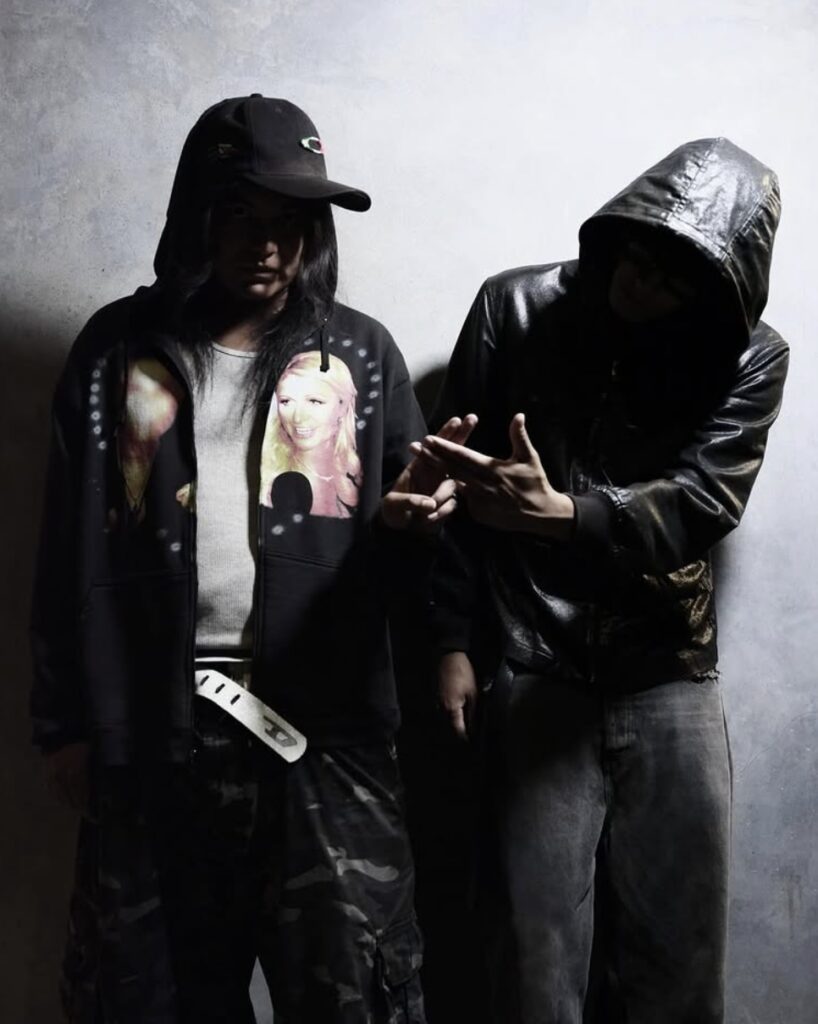
The premise was simple and tongue in cheek: “Let’s make the first corrido about doing K.” The idea wasn’t entirely unprecedented; the corrido, a form of Mexican regional music that dates back at least as far as the early 19th century, has long been used to tell tales of outlaws and miscreants. As illicit drug smuggling across the U.S.-Mexican border flourished, narcocorridos were born to relate romantic stories about the cartels that ran the trade. And in 2019, Sonoran singer Natanael Cano created corridos tumbados, injecting the genre with a dose of trap music from the States.
Nico Malva and Henny Fay were on the cusp of their 20s when Cano’s music first hit the streets. Fay, who was raised in East Hollywood and Pomona, says it was invigorating. “Growing up here, there was a kind of shame around Mexican music that you inherit just from living in America,” says Fay over a video call. “A lot of people in our age group were not accepting of corridos,” Malva, raised in Sinaloa and San Luis, Arizona, agrees. “Then Natanael Cano popped off. Now they’re like, ‘Okay, I can bump this music.’”
Over the past six years, statesiders Latin and non-Latin have come to know and love corridos tumbados via the likes of Peso Pluma, Fuerza Regida, and Junior H. The genre is divisive; several Mexican cities and states have attempted to ban narcocorridos outright, claiming they contribute to cartel violence. Many of these artists live north of the border, though, and it’s in this environment, away from the most intense regions of cartel activity, that Malva and Fay birthed Corridos Ketamina, a band and — if they have anything to say about it — a nascent youth movement.
CK’s music isn’t cartel music, but they wear their lineage proudly on their sleeves. “We made it a point to make music that people in our age group could embrace without feeling like a minority,” Malva says. “We don’t want to frame our project as a struggle; we want to have a power culture attached to it.”
Corridos Ketamina introduced themselves to the world with an Instagram post in January 2024 — a roughly 30-second song that wouldn’t be officially released as “ODIAME MÁS” until this August, when they dropped their self-titled debut EP. With the song came a video featuring the band’s official logo, an abstract, silhouetted play on the Mexican flag, on which an eagle devours a serpent.
The rest of their album rollout, which began in earnest with the release of their debut singles “V-NENO” and “KETITZ,” took roughly a year, with each song released alongside a video. “Me and Henny love world building,” Malva explains. “The music has to match the swag, and the swag has to match the visuals. Each track has its own essence, so we gave it its own era.”
The tracks themselves are varied, too. “KETITZ” is perhaps the most emblematic of the duo’s ethos, a corrido soaked in Auto-Tune telling a tale of toxic love. Others, like “MY SLUT,” lean into a deeper-fried hyperpop aesthetic, while others still — “V-NENO,” for instance — sound like punk ballads drowned in codeine. This sort of genre hybridization is generally accomplished by addition, layering one thing on top of the other. But Corridos Ketamina are content to let their own keen aesthetic tastes guide them to the intersection of their interests.
Right now, Fay and Malva are gearing up for three major shows in San Francisco, New York, and San Jose, where they’ll open for Iceage’s Elias Rønnenfelt, Dean Blunt collaborator Joanne Robertson, and kindred aesthetic spirits Dinamarca and Meth Math, respectively. Together with the new EP, it feels like the first major step to something much bigger.
How would you define Corridos Ketamina in relation to corridos tumbados?
NM: We’re adding to the street life that’s been talked about. Fuerza Regida are really big on being from the hood in the States. Me and Henny have that hood appeal too, but we also have an alternative way of seeing it. The homie David [Morales] runs a rave crew called Power Source, so we’re familiar with that scene too. We’re seeing people doing NOS, banging on the speakers till 4 a.m.
HF: We’re a living representation of our music. We’re combining all these elements of what it means to be Mexican-American.
NM: When you live in a border town like I do, you see the two different sides of the culture so clearly, and a lot of people are trying to imitate that without really understanding them. It’s harder to combine these kinds of ideas that me and Henny have, but it comes so organically to us.
We’re a living representation of our music. We’re combining all these elements of what it means to be Mexican-American.
I hear a lot of Lil Peep in your music. Is he a big influence for y’all?
HF: Not directly. Maybe it’s just our vocal chain or the way we approach tracks. I love Peep; his voice was super heavy, almost like a guitar. But I’m not sitting down in the studio like, “Okay let’s reference Peep.”
NM: It’s mostly Atlanta rappers we love: Carti, Young Thug, Future. We like how they use heavy Auto-Tune. But we’re laying it down on an alternative beat, so I think that’s why it might come off that way.
The lyrics of “KETITZ” reminded me of Future, actually. It’s about this toxic, drug-fueled obsession, but it’s also weirdly sweet.
HF: I’ve studied a lot of [Atlanta rappers’] music, just naturally being attracted to their flows and where they took the whole genre stylistically. I’ve always studied Young Thug’s flow, so when I’m writing lyrics, I always think of the best Young Thug or Future bars.

What’s your favorite young Thug bar?
NM: I actually have one off the dome. It’s from his verse on the scrapped version of [“Famous”] called “Nina Chop.” Thug says, “I just came from Europe, my money colored like a clown.” That’s why on “CEPILLÍN” I shout out the Mexican clown Cepillín: “Billetito Cepillín colorado.”
HF: That’s how that’s how we do it with the bars. We’ll translate them and find a way to make it flow in Spanish. No one knows it’s a Young Thug reference, but to us it means something. We have those layers in our music, and sometimes I just want to spoil them, but that’s what makes music timeless: As you listen to it, you find new things.
I’ve gotta ask: What is a ketitz? What does it mean to “hacer un ketitz?”
NM: It’s a cute way to say you’re doing a bump of ketamine. It sounds kind of like a Pokémon.
You’ve really mastered the art of the short song on this record. Do they just come out that way, or do you start with something longer and edit it down?
HF: There’s no real structure in how we write our songs. We always try to go about it in a new way for every track. Maybe it’s because of our attention span, but we tend to create very quick, hip-hop inspired songs, timing wise. For our next project, we’ve been challenging ourselves to write longer songs, but we do love those quick bops with all these instruments and all these components.
NM: I feel like music listening has changed in the last five years or so with songs getting shorter because of people’s attention spans, but there’s a shift that I can feel intuitively now where people are more willing to sit down and digest a song rather than, “Where’s the drop?”
Tell me more about that next project.
NM: We’re still developing the timeline of when we want to drop it — probably near the end of 2025 or early 2026. This first EP was raw and alternative; the second one is gonna be the same sound but perfected because, like Henny said, he knows how to mix these kinds of tracks now. So we’re trying to do a poppier take on corridos now, more upbeat but still with that alternative feel to them.