
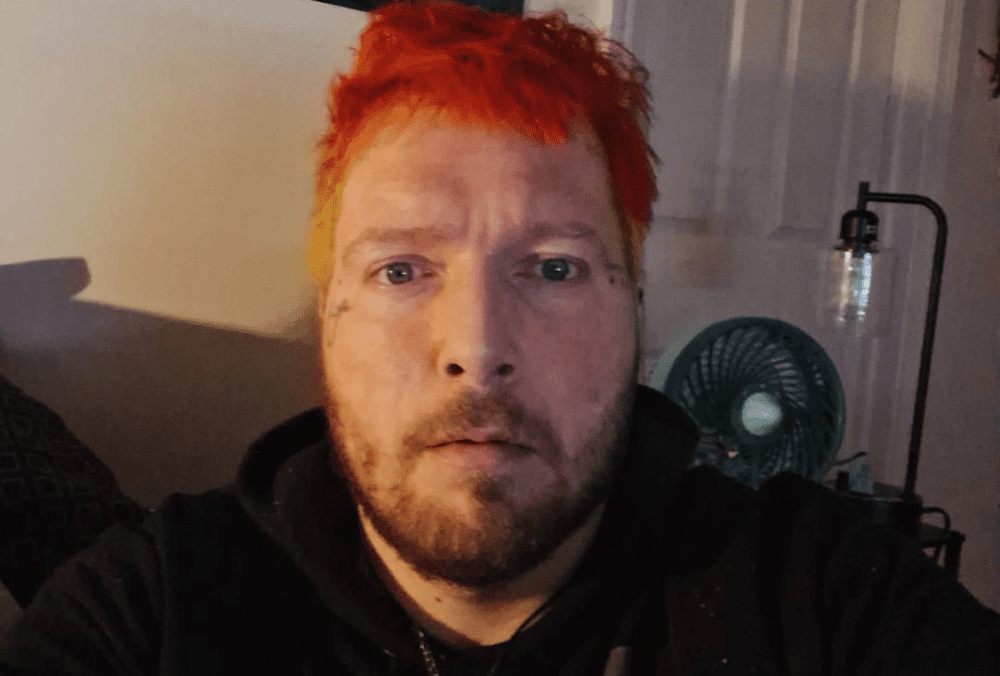
Young Meepa has never been interested in making music that goes down easy. Across the MXTPE series, he’s built a world rooted in lived experience—addiction, loss, political rage, and the kind of clarity that only comes from having nothing left to filter. With MXTPE #3: dystopia… Pt. 1, he doesn’t expand that world so much as pull you deeper into it, delivering a project that feels less like a release and more like a document—raw, unresolved, and entirely his own.
Q: Your MXTPE series feels like an evolving story rather than separate releases. What does dystopia… Pt. 1 represent to you in this bigger narrative?
A: It started off as a mixtape — that’s where it began, and it began with birth because that’s where shit begins. Then it developed into misanthropy because as I grew up and was socialized, I hated humanity more and more — because of how they treated people, how I was treated, how I viewed things. Then very quickly it turned into dystopia because I was being groomed, dropped out, got my GED on my 16th birthday, and by 17 or 18 got addicted to heroin. So it went from birth to misanthropy to dystopia very quickly — and that’s why there’s dystopia volumes 1, 2, and 3.
Q: There’s a strong sense of tension in this project — between the internal and the external. Where were you mentally and emotionally while creating it?
A: It’s extremely layered. At times I was living it up, squatting mansions. Other times I was working at Home Depot, living a very normal life in North Aurora, a suburb of Chicago. Then there were times I was traveling, living in Detroit, having the best and worst time of my life. When you ask about this project, you’re asking about my life in its entirety — the very first song on any of these releases goes back to when I was 8 or 9 years old.
Q: The title dystopia suggests a world that’s already here, not some distant future. What realities were you reacting to when putting this project together?
A: Our entire life — capitalism, the fact that we murder and break our bodies for pieces of paper, for zeros and ones on a screen. The Trump thing, the genocide, the Epstein thing, sacrificing and raping children going back thousands of years. Think about three dimensions, four dimensions, five dimensions — all of them dystopic. That’s where we’re living. If you don’t agree with that, you’re either uninformed or on something I need to know about.
Q: Tracks like “When I Die” and “Cops Need Not Apply (Get a Real Job)” feel direct and unapologetic. Do you approach writing from a place of intention, or does it come more instinctively?
A: “Cops Need Not Apply” came from Chicago’s ICE invasion — I just thought, why don’t they get a real job? Anyone who thinks law enforcement is a legitimate job is insane. It’s like arguing that German guards were just doing what they were told — yeah, and they killed people’s families. Fuck that thinking. “When I Die” was more personal — within a two-to-three month period, my fiancé and I both lost our mothers. I’ve also been into the occult for a lot of my life, and there’s a lot of layover in that. I’m not fully ready to go deeper on that one right now.
Q: Your music doesn’t shy away from political and social themes. Do you ever feel pressure to balance message and listenability, or is that not something you think about?
A: I don’t think I’ve ever had a choice. Who you are and who you are as an artist are one and the same — just like how religion and politics are the same thing, how we’re socialized is political. To be alive is to be political. And I hate politics — I hate liberals, I hate conservatives, I definitely hate fascists, sometimes I even hate anarchists. I just hate everyone, honestly. That’s where misanthropy comes from. But no, I’ve never tried to separate the two. I wish I could, but there is no separation.
Q: Compared to birth and misanthropy, how has your sound evolved on this project?
A: It evolved naturally. The first one was naturally about being born, then forced into misanthropy through having to exist with people, and then dystopia is just the opposite of utopia — and sadly that’s what we live in now. Without giving too much away, part one is just the beginning. There’s part two, part three, and then something else coming after that. I’ll have to leave it there.
Q: There’s a rawness to your delivery that makes everything feel very immediate. How important is authenticity versus structure when you’re recording?
A: Both matter, and it comes across naturally. If you’re building a pyramid, you have the structure — but I hope you’re having fun while you build it. Everything I write feels very real, but I also have fun with it. I think that balance answers the question.
Q: Miami has a very distinct energy — vibrant, chaotic, expressive. Do you see your music connecting with that kind of audience?
A: For sure. When I think of Miami and Florida, I think of XXXTENTACION — and I think he was murdered, honestly. But whatever he had, he had a real voice and a raw message. He talked to people who didn’t have that kind of language — he was almost like an interpreter, speaking English but saying something so much deeper than English. I’ve never actually been to Miami proper, but I was in Miami Beach years ago with a sugar daddy who was Obama’s aide — Obama, your secrets are safe with me, just kidding. lol
Q: The project is labeled as Part 1. What can listeners expect from the second half, and how does it expand on this chapter?
A: Parts one, two, and three aren’t quite a trilogy like Lord of the Rings — it’s more like a progressive story, the way someone actually lives their life. What happened from 10 to 15, then 14 to 19, then 18 to 24. And things keep happening in real life, so things become more immediate. The Epstein situation, for example — we just learned that the people who run this world are sacrificing children to ancient deities, and that absolutely affected whatever part of dystopia I’m writing now. Billionaires are evil. There’s no other way around it. I’m still shook.
Q: When someone finishes listening to MXTPE #3: dystopia… Pt. 1, what do you hope stays with them the most?
A: Honestly, I’m not sure — I feel like people don’t usually take me seriously. But I guess it’s just this: you can be pissed off and empathetic at the same time. You can hate a person but still try to understand where they’re coming from. Understanding this world a little better. At the same time, I won’t lie — I love calling out haters, attacking people I find to be homophobic and hypocritical on the record. I’m still relatively young, and I’m trying to have fun while telling my truth and other people’s truth.
Q: You’re building a world across these releases. Outside of music, what influences are shaping that vision right now — visually, culturally, or philosophically?
A: All three, in different ways. There’s this collective called CRIMETHINC — spelled like “thought crime” from Orwell’s 1984 — they’re doing really interesting political work. In my neighborhood I was involved in Food Not Bombs, which was basically asking: why are we bombing poor people when what they actually need is food? We’d collect food that would otherwise be thrown away, never prepared anything with meat, and you’d meet really real people out there. And it wasn’t some liberal do-gooder thing for me — I still need Ambien or Xanax to sleep. It was just about being out there, seeing real people, experiencing the world.
Q: As an independent artist, what’s been the biggest challenge in getting your message heard the way you intend?
A: Shadow-banning. Having my message completely disappear. If I mention certain countries, or unalive people based on politics or their skin color, my content just vanishes. Being shadow-banned, being labeled an extremist — that’s the biggest obstacle.
Q: If someone is hearing Young Meepa for the first time through this project, what’s the one thing you want them to understand about you immediately?
A: That to an extent, this world can be what you make of it. My fiancé is a Jewish, Native American, Italian, German, European person — someone you’d never guess was queer or into guys — and we’re officially getting married. Don’t let the haters create a narrative for you. You are who you are, no matter what anyone says. Fuck the haters.